

Make / Model Search
News - HyundaiVirtual validation accelerates Hyundai EV developmentHyundai compresses months of vehicle testing into hours with advanced simulator31 Jul 2026 HYUNDAI Motor Group has detailed a new high-fidelity driving simulator it says will dramatically reduce vehicle development time by allowing engineers to validate multiple vehicle configurations in a virtual environment before physical prototypes are built.
Located at the company's Namyang Research and Development Centre in South Korea, the new facility forms part of Hyundai and Kia's expanding digital engineering program as the industry grapples with increasingly complex vehicle development spanning electrification, software-defined vehicles and autonomous driving.
Hyundai said the proprietary virtual validation platform has been in development since 2014, but its value became particularly evident during the COVID-19 pandemic when overseas testing programs were disrupted by travel restrictions, exposing the limitations of relying solely on physical validation.
Completed after about 10 months of construction, the simulator enables engineers in Hyundai and Kia's global R&D network to collaborate within a shared virtual development environment.
The system centres on a 270-degree curved projection screen using nine 4K projectors operating at 240Hz to create what Hyundai describes as a near-photorealistic driving environment.
A six-degrees-of-freedom motion platform replicates longitudinal, lateral and vertical movement, together with roll, pitch and yaw, allowing engineers to accurately assess vehicle dynamics without leaving the laboratory.
The carbon-fibre cockpit uses production-style seating, steering wheel and pedals, while motion feedback recreates road surface vibrations of up to 40Hz, enabling detailed assessment of suspension performance, ride quality and tyre behaviour.
A critical feature is Hyundai's proprietary ‘terrain server’ technology, which streams only the section of road immediately surrounding the virtual vehicle rather than loading an entire road network.
Hyundai said the approach significantly reduces computing requirements while maintaining ultra-high-resolution graphics, with terrain data refreshed in less than one second to provide uninterrupted simulation across long distances.
To ensure accuracy, engineers digitally mapped the Namyang proving ground at one-millimetre intervals, capturing road texture, gradients, bumps and drainage features to create what the company says is a one-to-one digital replica of the test facility.
The simulator allows engineers to adjust vehicle parameters in real time, compare multiple calibrations back-to-back and assess conditions such as wet-weather performance without waiting for suitable track conditions.
Hyundai said the technology shortens development cycles by allowing engineering changes to be evaluated immediately, reducing the need to manufacture successive prototype vehicles during the calibration process.
Hyundai Dynamics’ functional concept development team senior research engineer Pilyoung Jeong said that the biggest challenge was building the software environment. "We had to reconfigure the vehicle dynamics analysis tools used at Namyang R&D Centre for the simulator environment while ensuring real-time operation of the motion platform without latency,” he said.
“It was a highly complex integration process, but the simulator's exceptional fidelity in replicating real vehicle behaviour made the effort worthwhile.”
The facility is already being used in the development of Hyundai and Kia passenger vehicles, Genesis Magma performance models, Hyundai N products and motorsport programs, including vehicles destined for testing at Germany's Nurburgring.
Hyundai said future applications will extend beyond vehicle dynamics into autonomous driving validation, artificial intelligence-assisted development and broader physical AI research, with additional simulator facilities under consideration.
“The most important part is helping with faster decision-making,” Mr Jeong said.
“The simulator lets us verify performance improvements before and after changes easily and quickly, which speeds up decision-making and lets us put more effort into making better cars.”
Hyundai believes the simulator will allow a greater proportion of vehicle validation to be completed virtually before physical prototypes are constructed, reducing development time and engineering costs while maintaining testing standards. 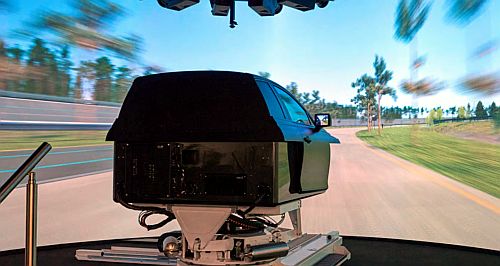 Read more |
Click to shareHyundai articlesResearch Hyundai Motor industry news GoAutoNews is Australia’s number one automotive industry journal covering the latest news, future and new model releases, market trends, industry personnel movements, and international events. |



Connect with us


Facebook Twitter Instagram