

Make / Model Search
OptionsCar reviews - Mitsubishi - Triton - Long-Term TestMitsubishi modelsOverviewThe Triton’s tech and ergonomics go under the spotlight in this long-term test update9 Dec 2025 By MATT BROGAN Update #3 – Technology & Ergonomics
THE Mitsubishi Triton long-term evaluation is tracking well as we head towards the Christmas break, with this update centred around on-board tech – and how well it works – and cabin ergonomics. In short, it’s about living with and in the cab as many Triton owners would.
Being the GLX+ grade, the Triton long-termer isn’t exactly brimming with technology. It has manually adjustable seats, vinyl flooring, a keyed ignition, and a standard four-wheel drive system without the centre locking differential found in higher grades.
But it also offers a very generous level of standard equipment for the price – some of which is not found in the Triton’s same-priced competition. We’re talking things like single-zone climate control, wireless Apple CarPlay and Android Auto connectivity, a rear diff lock, and auto lights and wipers.
So, what works well, and what needs improvement?
Well, we’re glad you asked.
As you might expect at the price point, there are a couple of letdowns in the performance of the tech at hand.
We found the low beam headlights short of reach and spread when compared with LED examples offered in higher grades and were disappointed with the roof-mounted air circulator that is both noisy, and in our view, ineffective.
Likewise, we found the idle-stop system incredibly slow to reignite, taking seconds (and not tenths of seconds) to restart the engine and get underway. Honestly, for safety’s sake, it’s one of those things we are glad can be disabled at the push of a button.
In the middle of the road in terms of performance is the Triton’s ADAS systems… or at least the driver monitoring technology. While the majority of the driver assistance systems are cooperative and well calibrated, the driver monitor is anything but. The system chimes in when you’re performing a head check or looking through a complex intersection, insisting that your eyesight must be kept straight-ahead at all times and without deviation.
Again, this system can be turned off, but that raises the question of its usefulness. If your first inclination is to deactivate a feature that is meant to be of use, then we question the point of installing it in the first place.
OK… that’s the negative technology dealt with.
Elsewhere, we are pleased to note the Triton’s tech works very well. The instrument screen is simple and easy to read and its menu system relatively straightforward. We had no trouble adjusting settings or accessing the trip computer, which is something a few newcomers to this segment could certainly take a lesson from.
The infotainment array is likewise easy to use, even if, perhaps, it is not as modern as, say, the new Toyota HiLux, Ford Ranger, or Volkswagen Amarok. The screen is rather clear and the reversing camera acceptable and sound quality from the audio system is decent considering the grade.
We had no trouble connecting our phones, making phone calls or streaming audio wirelessly, the vehicle maintaining a steady connection with our Apple iPhone every time we jump behind the ‘wheel.
It was also pleasing to find the single-zone climate control was very effective in changing Spring weather, cooling the cabin quickly when required and operating steadily and with little intervention the rest of the time.
And while the controls of the Triton are a little, shall we say, commercial in their appearance and action, they are nonetheless simple to use. The gearshift and column stalks fall easily to hand, as does the manual park brake. We found the tilt and reach steering adjustment well placed to our requirements, and the relationship between the seat and pedals hard to fault.
If we were to be picky, however, we note that the door mirrors fail to offer much vision past the alloy tray, which can make trailer reversing somewhat challenging. Like Toyota, it would be handy if Mitsubishi offered an accessory mirror spacer to set the door mirrors further from the frame, enabling the driver to ‘see past’ the tray and behind the vehicle.
Away from that sticking point, the Triton’s vision is rather good. The view forward is unhindered, and the A pillars are not so thick as to hinder the view in roundabouts. The rearward view is, of course, somewhat obscured by the headboard, but given its purpose, we believe this is a compromise we’ll happily take.
There is an acceptable level of storage inside the Triton’s cabin, though vent level drink holders would have been a nice inclusion. We found sufficient USB and 12-volt outlets for our needs, and handy door pockets and an open glove compartment for work gloves, gate keys, and tie-down straps.
The hard-wearing plastics therein seem to resist scratching very well, as do the fabric seats in combatting wet work clothes and grime (sorry, Mitsubishi!).
Visit GoAuto again soon for our next long-term update of the 2025 Mitsubishi Triton GLX+ or click on the links below to read past updates.
2025 Mitsubishi Triton GLX+ long-term test:
 Read more14th of November 2025  2025 Mitsubishi Triton Long-Term Test – Part 2We hitch our wagon to the long-term Triton to see how it performs as a tow vehicle30th of October 2025  2025 Mitsubishi Triton Long-Term Test – Part 1Mitsubishi’s strong-selling Triton ute joins the GoAuto garage for three months3rd of April 2025 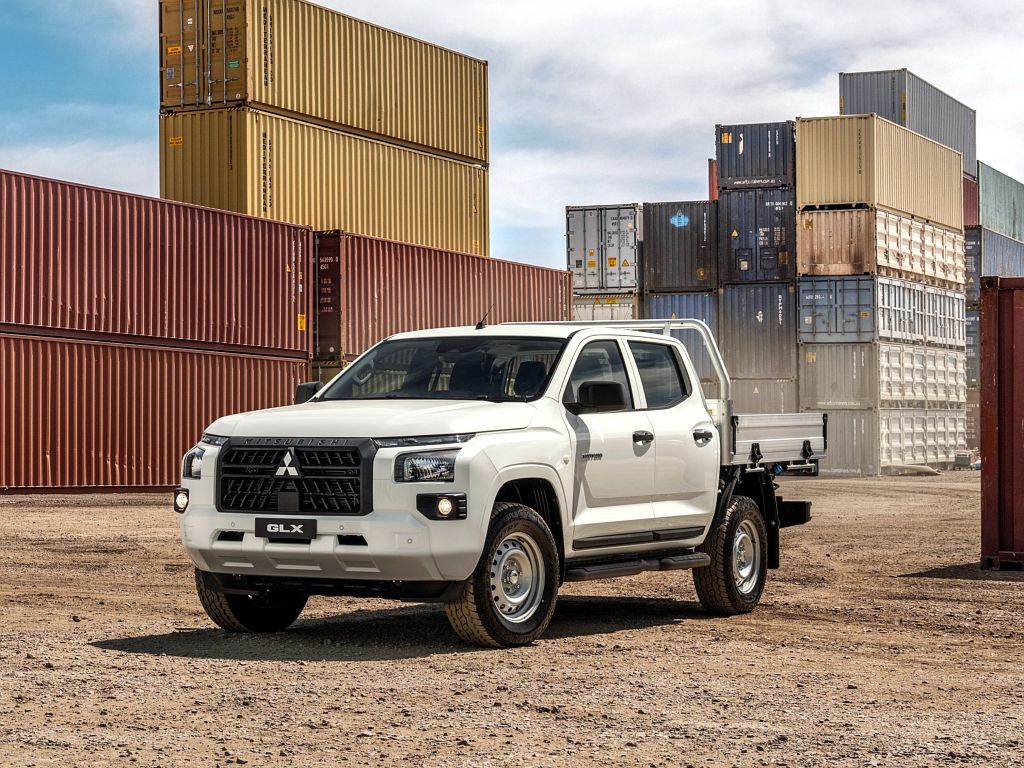 Mitsubishi adds body styles to Triton rangeMore Triton choices available soon as cab-chassis, Single and Club cabs filter through |
OptionsClick to share
|


 Alfa Romeo
 Abarth
 Audi
Audi Aston Martin
 BMW
BMW Bentley
 Ferrari
 Chevrolet
 Ford
Ford Fiat
Fiat GWM
GWM Foton
Foton Hyundai
 Honda
Honda Jaguar
 Isuzu
Isuzu Kia
Kia Jeep
Jeep Land Rover
 Lamborghini
 Maserati
 Lexus
Lexus McLaren
 Mazda
Mazda MG
MG Mercedes-Benz
 Mitsubishi
 Mini
Mini Peugeot
 Nissan
 Ram
Ram Porsche
 Rolls-Royce
 Smart
Smart Skoda
Skoda Suzuki
 Subaru
 Toyota
 Tesla
Tesla Volvo
Volvo Volkswagen
 Zeekr
Zeekr


Connect with us


Facebook Twitter Instagram